
Go With Kids.Com
Have kids will travel
Europe
Fairytail Finland
Christmas Finland
Heart of Ireland
County Fermangagh
Heart of England
Czech Republic
Saxony
Prague
Greek Delights
Disneyland Paris
Budapest
Austria
Legoland - Denmark
North Africa
Morocco
FAMILY FUN in FRANKFURT
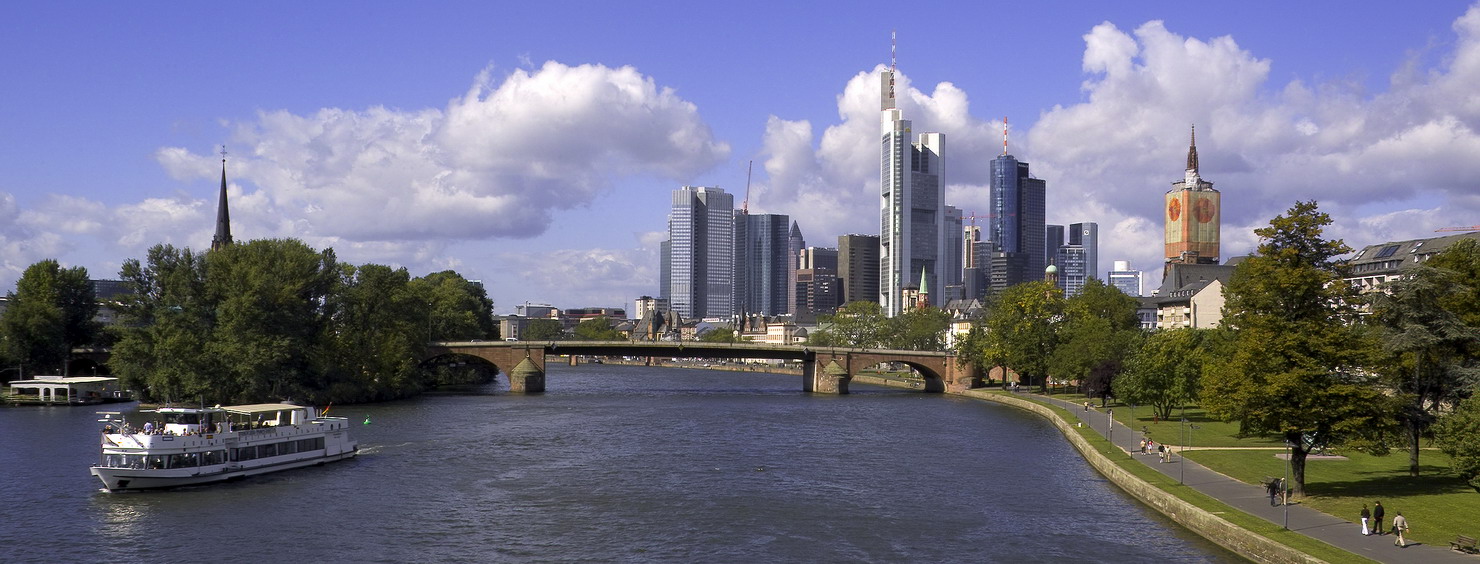
Frankfurt is often seen only as a transit hub or a business centre, but it's so much more. It boasts Germany's most spectacular skyline, mirrored in the Main River, and Europe's tallest office building, but it's also the country's most international town with more than a quarter of its citizens being foreign. Johann Wolfgang von Goethe, Frankfurt's most famous resident, once said that " Frankfurt is full of curiosities", and there is still a lot of truth in these words today. One such curiosity is the interplay between the traditional and the modern, which is manifested in the mishmash of towering skyscrapers and tiny, half-timbered houses. Despite its nicknames of "Bankfurt", "Mainhattan" (derived from the Main river) or "The Big Appel" (due to its famed apple wine industry), the city has many interesting places to visit and things to do for families.
The city
After severe Allied bombing in March 1944, Frankfurt's Altstadt (old town) was almost completely destroyed. Yet there are still many sights to see here - the Römer, Leinwandhaus, Paulskirche, Dom and Goethe Museum are only a few yards apart from each other. If you want to go shopping you'll find plenty of shopping malls, such as the Schillerpassage or the Fressgass Passage. Evening entertainment in the form of theatre or other cultural pursuits can be found in places like Schmiere, Tigerpalast or the Volkstheater. A great way for families to see the city is a tour with the historical tram Ebbelwei-Express. Aboard the multi-coloured streetcar you can enjoy Frankfurt’s famous apple wine - the local drink of preference – preztels and music while being taken through Frankfurt’s old town centre and the apple wine district of Sachsenhausen.
Bahnhofsviertel
In the 1920s, more than 20,000 people lived in the ornate houses close to the main station, the Hauptbahnhof. Today the Bahnhofsviertel (station quarter) is home to just 4,000 residents, the English Theatre and the Chamber Choir, as well as numerous bars and restaurants. Business people still flock here after finishing work in the nearby Banking Quarter, so there are plenty of places to choose from if you are looking for a good meal at reasonable prices.
Bockenheim
The district of Bockenheim, home to Frankfurt's Johann Wolfgang Goethe University and some 40,000 students, is extremely lively. The cafes, bistros, pubs, and shops near the university have focused their attentions on the young clientele making it a vibrant and interesting place to visit. The Theater am Turm, in the former tram depot, is one of Frankfurt's top addresses for theatre and ballet productions.
Bornheim
The lively village of Bornheim spans the divide between the traditional and the trendy. The olde worlde cider pubs, lively new bars, exclusive boutiques and simple corner shops attract a mixed clientele. At the heart of this residential area is Berger Strasse, an ideal place for a bit of shopping. There's plenty of entertainment here in the Mousonturm, Berger Cinema and Ice Rink, and if you are looking for somewhere to relax try the Chinese Garden.
Höchst
The district of Höchst, which gave its name to the world-famous paint factory, was incorporated into Frankfurt in 1928. The old town and the Bolongaro Palace on the Nidda estuary have been undergoing careful restoration since the 1970s. The Neues Theater Höchst is a busy cultural centre with cabaret, comedy and a popular children's theatre.
Nordend
The most densely populated and popular residential area of Frankfurt, Nordend boasts attractive streets and quaint 19th century houses, as well as numerous pubs and small shops. The area used to be dominated by the left-wing alternative scene but is now home to a community of wealthy bankers who live here alongside the student population. The area has many Italian, Greek or Turkish restaurants, and bars such as Harveys or Kasimir.
Ostend
Once a run-down working-class district, Ostend is today a much sought after residential area. This neighbourhood now has much more to offer than just industrial parks, it also has countless ornate villas and plenty of culture and entertainment possibilities. Literary enthusiasts meet in the Romanfabrik, while young party people head for the Loft House. Furniture design shops such as Kontrast, as well as dozens of advertising agencies and film producers, have moved into the old warehouses in the area.
Sachsenhausen
The district of Sachsenhausen on the opposite bank of the River Main is known for its cider and its old, half-timbered houses. Old Sachsenhausen has lost some of its charm over recent decades due to war and political strife, but it still has a lot to offer, like the elegant town houses on the river bank and fine boutiques on the elegant Schweizer Strasse. Also here is the Museumsufer ('museum bank') where seven important museums are located, most of them housed in magnificent 19th century mansions.
Westend
Westend is situated in the shadows of the skyscrapers and high-rises that are home to the city's banks and financial companies. In the seventies, the district was full of students and squatters demonstrating against the destruction of the area's old buildings. Today, offices and banks lend the area its character, and owners of the luxury flats and penthouse suites meet up to jog in Grüneburg park or relax in the Palm Garden. The recently restored Synagogue, the monumental IG-Farbenhaus and the Alte Opera are all well worth a visit.
PLACES TO VISIT
Palmengarten

Originally established in 1869 to house the Duke of Nassau's plant collection, the Palmengarten ( Palm Garden) contains a stunning array of exotic plants. Visitors are free to wander at will through the gardens, although the guided tours are recommended for those who want to learn more about the plant world. Numerous activities take place throughout the year, including open-air classical concerts in the summer, the Festival of Light in June, the Autumn Festival in September and the Orchid Festival in October. Explore the 50 acres of gardens, or visit the historical greenhouses including the Tropicarium which houses a vast collection of tropical plants including orchids, and there's a small boating lake in the middle of the park.
www.stadt-frankfurt.de/Palmengarten
Dom Museum
This permanent exhibition documents the importance of the Dom (Frankfurt Cathedral) as the city's first parish church and as a place where German kings and emperors were crowned and elected. The intention is for visitors to gain an understanding of the cathedral's background and history. The museum was opened in 1987 and the main attraction is without doubt the collection of priceless religious treasures and other gold artefacts, although much of the collection has gone missing over the centuries. Also on show are valuable discoveries from a grave dating back to the late Merovingian period and mass robes from the 14-20th century. Visitors can also find information on the history of the construction of the cathedral during the Middle Ages and its changing fate in the 19th century.
Schaumainkai , the quay on the southern bank of the River Main between Friedensbrücke and Dreikönigskirche, is also known as Museumsufer ('museum bank'). Seven important museums are clustered here, most of them housed in magnificent 19th century mansions. The Liebieghaus, Städel Art Institute, Communications Museum, National Museum of Architecture, National Film Museum, Museum of Popular Culture and the Museum of Applied Arts are all dotted around the wonderful landscape gardens which were originally laid out in the 19th century. In September the quay hosts the three-day Museumsufer Festival, one of Frankfurt's most popular open-air attractions.
Goethehaus & Goethe Museum
The house where Goethe was born on August 28 1749, is a fine example of how the well-to-do lived in the late baroque era. In 1733 Goethe's family acquired two neighbouring half-timbered houses in Großen Hirschgraben. The family sold the property in 1795, by which time Goethe himself had already moved to Weimar. It is also worth taking a trip to the adjoining Goethe Museum, which was recently renovated and contains both a library and a bookshop. The house itself is a reconstruction of the original which was destroyed in the Second World War.
Senckenberg Museum
An ideal place for families is the Senckenberg Museum where one of the main attractions is the life-size models and skeletons of the dinosaurs. Here you can discover all you need to know about dinosaurs and other prehistoric life-forms, from giant mammals to birds, fish, amphibians, reptiles or insects. The mummies in the Egyptian section are also popular with younger visitors. Guided tours for children can be arranged in English and German
www.senckenberg.uni-frankfurt.de
Children's Museum
The Kindermuseum (Children's Museum) in the Historisches Museum ( Museum of Local History) aims to bring children closer to the past. Throughout the year, it offers events especially for children, including workshops, projects, activity days and special exhibitions. Model making, music and role-playing all help to make history much more fun than most kids would have ever thought! Special activities are organised during the school holidays.
www.kindermuseum.frankfurt.de/
Botanical Gardens
The well ordered and interesting Botanical Garden is administered by the University of Frankfurt. The gardens are designed to take visitors on a journey through different areas of the plant kingdom, from the hardwood forests of North America to the barren savannah of Africa. They cover more than eight hectares (20 acres) and contain more than 6,000 different botanical species, from exotic rainforest flowers to European weeds. A series of informative signs explains all about the different species and their natural habitats.
Freies Theaterhaus
This independent theatre acts as a stage for dozens of different local ensembles. Opened in 1991 in the former Jewish Community Centre, approximately 200 performances are made every year. The two stages host plays, musicals and concerts in the evening as well as daytime matinees for children. The theatre is also home to the Rhine-Main International Children's Festival.
www.theaterhaus-frankfurt.de
Stadel Institute of Art Kinderprogramm
The Stadel Institute of Art contains a wonderful exhibition of European paintings from the 14th century to the present day. The museum offers special services and events for children under 12, such as workshops, guided tours and art classes. Boys and girls have the chance to learn about a particular painting here and then put brush to canvas themselves. Additional programmes for children take place during the summer holidays, on the museum's open day and during the Museumufer Festival.
Kinder-Malkurse in der Schirn
The Schirn gallery in the heart of the old town stages exhibitions by individual artists, groups of artists, or by artists from a particular epoch. In addition to the exhibitions, there are also painting courses for children aged six to eleven where they learn how the works exhibited were created and which materials were used. They can then express themselves on paper or canvas and some of the children's work is then exhibited.
www.schirn.de/
Frankfurt Zoo
Frankfurt Zoo was established in 1858 and is one of the oldest in Germany. The zoo is linked closely with the name of the famous animal expert and researcher Bernhard Grzimek. After the War, it was Dr. Crzimek who took care of rebuilding the wrecked buildings and after being appointed as the zoo's director, he also took care of purchasing animals, new buildings and modern enclosures. The special attractions today are the tigers, lions and leopards, the snakes and spiders, and the so-called day and night house which simulates the night-time. The 11 hectare zoo now boasts over 600 different species and a total of 5,000 animals.
www.zoo-frankfurt.de/
Die Katakombe
The Katakombe theatre is well known for its magical children's performances, as well as for its quality evening shows for adults. Children's performances take place at the weekend and are fast and furious, with only a few actors handling the whole scene. The evening plays are often contemporary works, although classic plays by the likes of Goethe are occasionally scheduled.
www.katakombe-frankfurt.de/
Werkstattmuseum Kaleidoskop
The motto behind this hands-on museum is "learning by doing." Children are encouraged to poke, touch and create things themselves. All exhibits are made by the children, and deal with topics such as building, health, water and mobility.
www.kaleidoskop-frankfurt.de/
Mitmach-Werkstatt im Museum für Kommunikation
The development of postal transport is an important part of the exhibition in the Museum of Communication. A rich array of interesting objects are documented and explained - and all deal with the question of how to transport information from one place to another. Historic post boxes, uniforms, telephones and even postmen's carriages all throw light onto the days before the internet. There are audio-visual programmes, which are especially enjoyable for youngsters, and children can relive the exciting experience of riding in a postman's carriage.
www.museumsstiftung.de
Opel Live
Opel is to Rüsselsheim what Ford is to Detroit. If you want to know how a car is made, then this is the place to come. Here visitors can glide around the factory on a conveyor belt and watch all the different stages of production, and a new feature is the virtual reality section, where visitors can take part in crash tests, simulations and speed checks. A great day out for kids and adults alike.
Main Tower
Since being completed in 2000, the Main Tower has been one of the most outstanding sights in Frankfurt, and one of the most popular. At a height of 200 meters, it is the fourth highest and most visitor-friendly skyscraper in "Mainhattan". From the viewing terrace on the 54th floor you get spectacular views across the whole city and river, and the restaurant on the 53rd floor is very child-friendly and has good choice of food for all ages and tastes.
Outside the City
Opel Zoo
Situated in the middle of the forest near Kronberg in Taunus, this zoo boasts a fantastic variety of wild animals from every continent, including elephants, giraffes, zebras, hippos, monkeys and wild cats. The enclosures are large and designed with the animals in mind, and a special section contains farm animals which the kids can feed and stroke. There are a number of play areas with slides, trampolines, cable cars and a miniature railway. The zoo is named after Adam Opel, founder of the motor company which bears his name.
www.opelzoo.com
Taunus-Wunderland
This theme park in Taunus claims to 'bring fairytales to life', but the fairytale castle is no longer the main attraction. Visitors can now travel through an ancient world full of dinosaurs and Neanderthals, or experience earth's creation in a special slideshow. For the brave-hearted there is a haunted house and a roller-coaster, while a more sedate ride on the 'Western Express' is ideal for less-adventurous types. The action never stops; there is also a sky diver, giant slides, a big wheel, bouncing castles, a water carousel and much more. The whole place has recently been revamped and now boasts state-of-the-art entertainment for the whole family.
Freilichtmuseum Hessenpark
What would have it been like to live in the Middle Ages? Well, you can find out in the Freilichtmuseum Hessenpark, an open-air replica of a medieval village. Visitors can explore barns, stables and workshops, go to the post office and have a glimpse inside an old school and church. Many of the houses are kitted out with original furniture and equipment. There are daily demonstrations where visitors can see how bread was baked, plates turned and baskets woven, then people can go on a ride through the surrounding countryside, lead by Max the shire horse.
PLACES TO STAY
Villa Orange
Although a business hotel, they do have a family room and welcome children. The hotel is reasonably priced and ideally located for attractions, shops, restaurants and public transport. Parking here is limited to six spaces so it is advisable to book in advance.
Hotel Neue Krame
USEFUL CONTACTS
email: info@gowithkids.com